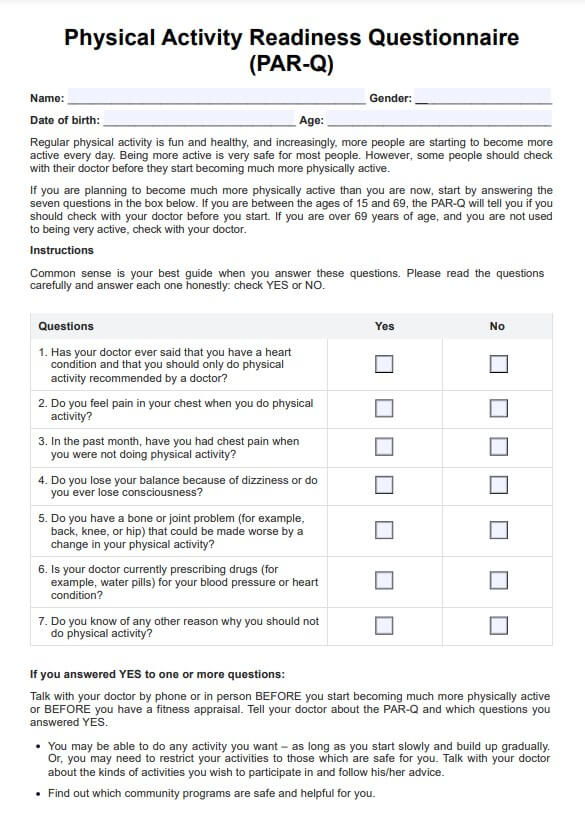
Looking for a tool to help assess the physical readiness of clients before participating in physical exercises? Read our guide to learn more about why it's important to be aware of this, then use our Physical Activity Readiness Questionnaire (PAR-Q) to assess your clients.
## **Why assessing physical readiness matters**
Before beginning any exercise program, it's essential to identify potential health risks that could make physical activity unsafe. Without proper pre-participation screening, individuals may engage in exercises that exceed their current capacity, which can then lead to serious complications.
Undiagnosed heart conditions, uncontrolled blood pressure, or musculoskeletal issues can be aggravated by sudden increases in activity intensity. Individuals with cardiovascular disease face increased risk during vigorous exercise, particularly if they have not been regularly physically active (Isath et al., 2023). Common adverse events include chest pain, dizziness, loss of balance, and, in rare but serious cases, heart attack or cardiac arrest during activity.
A risk stratification strategy helps fitness professionals and healthcare providers determine who can safely begin exercising and who needs medical clearance or closer supervision. This approach protects both the client and the practitioner. It can also reduce potential health risks and support safety across fitness facilities and clinical settings.
## **What is a Physical Activity Readiness Questionnaire (PAR-Q)?**
The Physical Activity Readiness Questionnaire (PAR-Q) is a simple, self-administered screening tool designed to help individuals determine their readiness for physical activity or exercise programs. The Canadian Society for Exercise Physiology (CSEP) developed the PAR-Q to identify potential health risks that may require further evaluation by a healthcare professional before starting an exercise regimen. While the PAR-Q is not a complete medical history, it helps uncover potential health risks and identify pre-existing medical conditions that might be aggravated by physical activity.
The questionnaire consists of seven yes-or-no questions that cover various aspects of an individual's health history, including chest pain during activity, balance issues, a bone or joint problem, prescribed medications, and other health concerns. The PAR-Q includes specific questions about heart conditions to identify any pre-existing health issues affecting a client participating in physical activity (Warburton et al., 2021).
While the PAR-Q is a valuable first step, it is not a complete medical history and has notable limitations. The tool relies on self-reported history and may miss undisclosed or undiagnosed conditions. This readiness questionnaire is best used as an initial screening tool rather than a definitive risk assessment. It does not replace clinical judgment or comprehensive evaluation by a physician or medical professional, especially for individuals with known chronic medical conditions, those who have experienced a past month of symptoms, or those of a certain age who are sedentary (Riebe et al., 2015).
The PAR-Q is typically administered to new clients interested in starting an exercise program, sedentary individuals who want to become more physically active, or clients experiencing changes in health status. It is also recommended as part of annual check-ins and when working with special populations who may have unique health considerations requiring additional screening and guidance before participating in physical activity.
## **How does this Physical Activity Readiness (PAR-Q) form work?**
Using our free PAR-Q form is quick and simple. It provides valuable insights into an individual's readiness to engage or perform physical activity recommended by a healthcare provider, fitness coach, or on their own. It is still important to seek medical advice before they begin exercising, especially if they have not been active for a long time.
This PAR-Q template is based on the original version of the questionnaire and includes the following sections:
- **Client information**: There is a space for name, date of birth, age, and gender. This ensures the form is properly attributed and can be referenced in the client's file.
- **Instructions**: This includes clear guidance on how to answer the questions honestly and what to do based on the client's answers. The instructions emphasize that common sense is the best guide and explain the next steps for both "yes" and "no" responses.
- **Seven core questions**: These questions identify key risk factors, such as diagnosed heart conditions requiring doctor-supervised activity, chest pain during or outside of exercise, dizziness, loss of balance, bone or joint problems, rescribed medications for blood pressure or heart issues, and any other reason the individual should avoid physical activity.
- **Next steps based on responses**: If a client answers "yes" to one or more questions, the template advises them to talk with their doctor before starting a fitness program. If they answer "no" to all questions, they can proceed with the activity but are encouraged to start slowly and build up gradually.
- **Signature and consent**: Space for the client (and parent/guardian if applicable) to confirm they have read and understood the questionnaire, which supports personal liability protection and informed consent.
Healthcare and exercise professionals can follow these steps to use this tool.
### **Step 1: Introduce the PAR-Q**
A personal trainer or healthcare provider can assist patients or clients in understanding and completing the PAR-Q. Explain the purpose of the PAR-Q and the process of assessing their readiness for physical activity. Emphasize the importance of answering the questions honestly and thoroughly.
### **Step 2: Administer the questionnaire**
Provide your client with the PAR-Q form and ensure they understand each question. Encourage them to ask for clarification if needed. Allow sufficient time for them to complete the questionnaire independently. In some settings, you may choose to review the questions together, especially with older adults or individuals with limited health literacy.
### **Step 3: Review the responses and complete medical history**
Carefully examine your client's answers to the PAR-Q. If they have answered "no" to all questions, they can likely engage in physical activity without requiring further evaluation. However, if they have answered "yes" to one or more questions, proceed to step 4.
### **Step 4: Discuss concerns**
For clients who have answered “yes” to any question, discuss their concerns and gather more information about their health history. It is crucial to identify risks such as heart attacks and the potential to lose consciousness during physical activity.
If further evaluation is needed, refer the client to a physician for a more comprehensive assessment and medical clearance before starting an exercise program.
### **Step 5: Document and follow up**
Record the client's PAR-Q responses and any referrals to a doctor made in their file. Follow up with the client to ensure they have received the necessary [medical clearance](https://www.carepatron.com/templates/medical-clearance-letter/) or guidance before proceeding with an exercise program. Regularly update the PAR-Q as part of ongoing client monitoring and care, and store their records in a HIPAA-compliant [patient record software](https://www.carepatron.com/feature/electronic-patient-records).
## **Tips for supporting clients who want to become physically ready**
Once your clients have been cleared to begin exercising, it's important to support them in building a sustainable and safe fitness routine. Here are tips to share with patients and clients looking to become more physically active:
- **Start slow and build gradually**: Encourage clients to begin with low- to moderate-intensity activities and increase duration and intensity over time. This approach reduces injury risk and supports long-term adherence.
- **Focus on consistency over intensity**: Regular activity—even at moderate levels—provides significant health benefits. Aim for at least 150 minutes of moderate-intensity physical activity per week, as recommended by the World Health Organization (World Health Organization, 2023).
- **Incorporate variety**: A well-rounded fitness program includes aerobic exercise, strength training, flexibility work, and balance activities. This is especially important for older adults and those with chronic medical conditions.
- **Monitor symptoms**: Teach clients to recognize warning signs such as chest pain, shortness of breath, dizziness, or unusual fatigue. If any of these occur, they should stop activity and consult a medical professional.
- **Set realistic goals**: Help clients create achievable, specific goals based on their current fitness level and health status. This builds confidence and reduces frustration.
- **Address barriers to activity**: Work with clients to identify and overcome common barriers such as time constraints, lack of access to fitness facilities, or fear of injury. Offering flexible, home-based options can improve engagement.
## **Reference**
Isath, A., Koziol, K. J., Martinez, M. W., Garber, C. E., Martinez, M. N., Emery, M. S., Baggish, A. L., Naidu, S. S., Lavie, C. J., Arena, R., & Krittanawong, C. (2023). Exercise and cardiovascular health: A state-of-the-art review. Progress in Cardiovascular Diseases, 79. https://doi.org/10.1016/j.pcad.2023.04.008
Riebe, D., Franklin, B. A., Thompson, P. D., Garber, C. E., Whitfield, G. P., Magal, M., & Pescatello, L. S. (2015). Updating ACSM’s recommendations for exercise preparticipation health screening. Medicine & Science in Sports & Exercise, 47(11), 2473–2479. https://doi.org/10.1249/mss.0000000000000664
Warburton, D., Jamnik, V., Bredin, S., Shephard, R., & Gledhill, N. (2021). The 2021 physical activity readiness questionnaire for everyone (PAR-Q+) and electronic physical activity readiness medical examination (departed-x+): 2021 PAR-Q+. The Health & Fitness Journal of Canada, 14(1), 83–87. https://doi.org/10.14288/hfjc.v14i1.351
World Health Organization. (2023). Physical activity. https://www.who.int/initiatives/behealthy/physical-activity