What is included in the WAIS-IV?
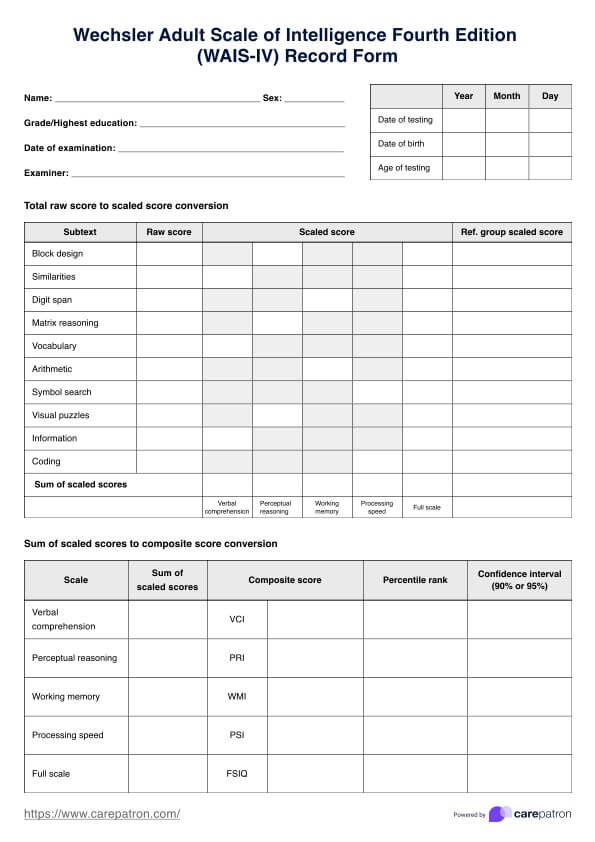
This WAIS-IV comprehensively assesses cognitive abilities across four principal areas, called index scores. These index scores are derived from performance on various subtests and provide valuable insights into an individual's cognitive strengths and weaknesses.
Verbal comprehension index (VCI)
This index measures verbal reasoning, comprehension, and conceptual abilities. It encompasses verbal tests such as vocabulary knowledge, information acquisition, verbal expression, and abstract reasoning. Subtests like Similarities, Vocabulary, and Information contribute to this index.
Perceptual reasoning index (PRI)
The Perceptual Reasoning Index evaluates nonverbal reasoning, spatial processing, and visual-motor integration abilities. It involves tasks like analyzing and synthesizing abstract visual information and perceiving and manipulating visual patterns. This index includes the Block Design, Matrix Reasoning, and Visual Puzzles subtests.
Working memory index (WMI)
This index assesses an individual's ability to temporarily store and manipulate information in short-term memory. It involves tasks that require holding and mentally manipulating numerical or verbal information. The Digit Span and Arithmetic subtests contribute to the WMI.
Processing speed index (PSI)
The Processing Speed Index measures the ability to quickly and accurately process visual information, as well as cognitive efficiency and fluency. Tasks like quickly scanning and matching symbols or numbers are included in subtests like Coding and Symbol Search, which contribute to this index.
Subtests of the WAIS-IV
The WAIS-IV consists of 15 subtests divided into core and supplemental subtests. These subtests are designed to assess various cognitive abilities and contribute to calculating the four index scores and the Full Scale IQ (FSIQ) score.
The core subtests include the following:
- Similarities: Measures verbal concept formation, abstract reasoning, and verbal expression.
- Vocabulary: Assesses word knowledge and verbal comprehension.
- Information: Evaluates acquired general knowledge and long-term memory.
- Block design: Measures spatial perception, visual-motor coordination, and abstract conceptualization.
- Matrix reasoning: Assesses nonverbal abstract reasoning and visual information processing.
- Visual puzzles: Evaluates nonverbal reasoning and visual-spatial processing.
- Digit span: The digit span subtest auditory short-term memory, attention, and concentration.
- Arithmetic: Assesses numerical reasoning, attention, and mental manipulation.
- Coding: Measures processing speed, short-term memory, and visual-motor coordination.
- Symbol search: Evaluates processing speed, visual perception, and concentration.
On the other hand, these are the five supplemental subtests:
- Figure weights: Measures quantitative and analogical reasoning.
- Comprehension: Assesses social judgment and common sense reasoning.
- Letter-number sequencing: Evaluates working memory and attention.
- Cancellation: Measures processing speed and visual attention.
- Picture completion: Evaluates visual perception and visual recognition.