Everyone has a story to tell, and here we share and celebrate those who chose care as their life's work.
These are their words, their work and we're grateful to share them.
Elizabeth and Dennis handed their billing to Carepatron and grew My Therapeutic Concepts from five clients to seventy in two months, without losing their evenings.
Understanding and expressing emotions is an essential part of mental and emotional well-being. Feelings Worksheets give clients a structured way to recognize, name, and explore what they’re experiencing, helping them connect emotions to thoughts, behaviors, and physical cues. In this guide, you’ll learn how to use these worksheets effectively, integrate them into therapy, and support clients as they continue emotional reflection beyond sessions.
## **What is emotion regulation?**
Emotion regulation is the ability to manage and respond to emotions in ways that promote well-being and connection. It involves recognizing emotional cues in the body, labeling them accurately, and choosing responses that align with one’s values or goals. This skill allows individuals to stay grounded during moments of stress, sadness, or anger, rather than being overwhelmed by intense feelings or reacting impulsively.
Developing emotion regulation starts with building a strong emotional vocabulary—the ability to name and describe what one is feeling beyond broad labels like “good” or “bad.” Recognizing basic emotions such as happiness, sadness, anger, and fear helps individuals connect their inner experiences to specific triggers and needs. As emotional awareness deepens, people can also identify more nuanced states like gratitude, hopeful, or even silly, which strengthens emotional insight and self-understanding.
In therapy, emotion regulation is often supported through mindfulness, cognitive reappraisal, and social emotional learning techniques that help clients pause, reflect, and respond intentionally. Therapists and caregivers may use tools like mood charts or journaling prompts to help students and adults alike practice identifying feelings and finding healthy outlets for expression. These approaches can make emotional growth feel approachable and even fun, encouraging clients to explore different emotions without fear of judgment.
Research consistently links effective emotion regulation with stronger mental health, more satisfying relationships, and improved resilience. According to Gross (2015), individuals who can flexibly manage their emotions experience fewer symptoms of depression and anxiety. Lane and Smith (2021) further highlight that emotional awareness, the ability to notice, interpret, and label emotions—is central to emotional development and empathy. Similarly, Spinrad et al. (2006) found that children who develop emotion regulation skills early in life are better able to manage stress and build positive social relationships, reducing their risk of later emotional and behavioral difficulties.
## **What is a Feeling Worksheet?**
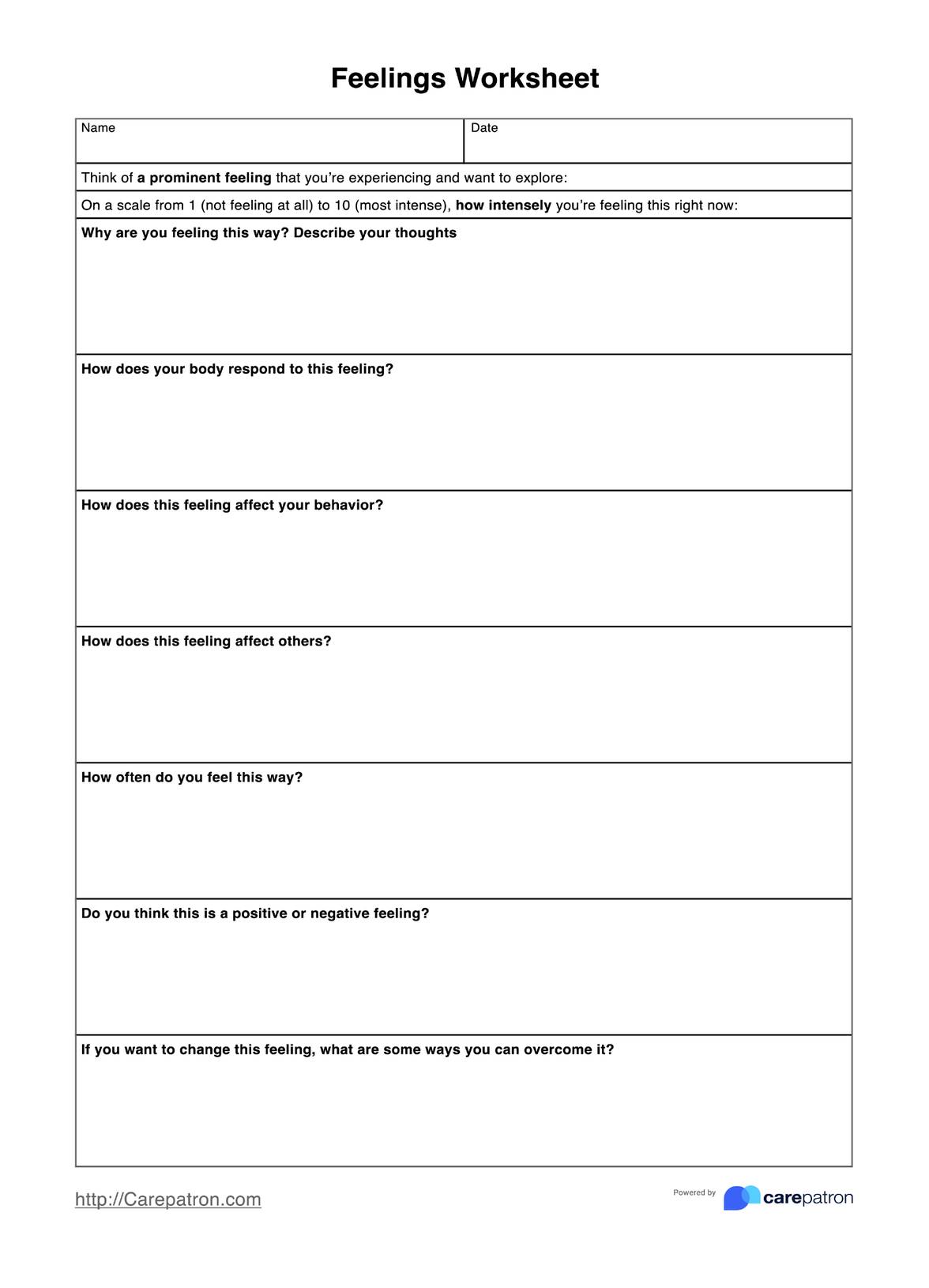
A Feelings Worksheet is a therapeutic tool used to help individuals identify, understand, and express their emotions in a structured way. These worksheets are often used in counseling, psychotherapy, and emotional skills training to promote self-awareness and support emotional regulation. They typically include visual or written prompts—such as emotion word lists, facial expressions, or rating scales—that guide clients in naming what they feel and exploring why those emotions arise.
Clinicians often use Feelings Worksheets with clients who struggle to recognize or articulate their emotions, including children, individuals with anxiety or depression, and those experiencing emotional dysregulation. By slowing down the process of noticing and labeling emotions, these worksheets create space for reflection and self-understanding. They can be particularly helpful when introducing clients to concepts like emotional awareness or when encouraging mindful engagement with difficult feelings.
That said, while Feelings Worksheets are a useful therapeutic aid, they are not a standalone intervention. They work best when used alongside guided reflection and discussion with a qualified mental health professional. Without context or clinical support, clients may misinterpret emotions or struggle to connect them to underlying experiences. Additionally, these worksheets focus on awareness rather than deep emotional processing, so they are most effective as part of a broader therapeutic approach that integrates coping strategies, behavioral techniques, or mindfulness practices.
## **How to use this Feelings Worksheet**
When integrating this Feelings Worksheet, here are some steps you can follow:
### **Step 1: Introduce the concept of emotional awareness**
Explain the importance of emotional awareness and its role in overall well-being. Help the individual understand that emotions are natural and valid experiences and that recognizing and labeling them is the first step towards effective emotion regulation.
### **Step 2: Identify emotions**
Provide the individual with a comprehensive list of primary emotions and other emotions or facial expressions. Guide them through the process of identifying and labeling the emotions they are currently experiencing or what they want to explore.
### **Step 3: Explore emotional triggers and responses**
Once the individual has identified and explored their emotions, they should refer to the worksheet to explore potential triggers or situations that elicited those emotional responses. They should also discuss how they typically react or express feelings and introduce the concept of emotional regulation.
### **Step 4: Introduce emotion regulation strategies**
Present various [emotion regulation strategies](https://www.carepatron.com/guides/emotional-regulation-skills/), such as cognitive reappraisal, mindfulness techniques, or distress tolerance skills. Guide the individual in practicing these strategies and provide feedback on their effectiveness.
For additional support, explore our [Cognitive Distortions Template](https://www.carepatron.com/templates/cognitive-distortions-pdf) to further enhance your practice and client outcomes.
## **Encouraging emotional reflection outside therapy**
Helping your clients reflect on their emotions outside of sessions is a great way to turn awareness into everyday practice. Real progress often happens in the quiet time between therapy visits, when clients have the chance to notice what they feel and why. Encouraging them to check in daily helps them identify patterns, regulate emotions more effectively, and build confidence in naming their experiences.
### **Make reflection approachable**
Start with something simple and accessible. A printed feelings list or color-coded worksheet can serve as a quick resource for clients to return to throughout the week. You might invite them to use one word to describe their day, or draw or shade how they felt in a certain moment — an easy example of how reflection can fit naturally into daily life. For kids, interactive activities like coloring emotion faces or matching feelings with body sensations make the process more engaging. For adults, journaling, short notes, or even digital mood trackers can work just as well.
### **Keep the process consistent**
Encourage clients to build consistency rather than perfection. Ask them to notice how their body feels when they’re angry, sad, mad, happy or content, and what helps those feelings settle. Over time, this habit creates emotional insight and a more nuanced vocabulary. You can also help clients find what method works best for them, whether that’s using a fridge chart, setting a reminder, or keeping a small journal nearby. The more personalized it feels, the easier it is to maintain.
### **Help clients carry awareness into daily life**
Emotional reflection doesn’t need to be long or serious to be effective. It can be fun, creative, or brief — a five-minute pause before bed, a drawing, or a color that represents their mood. The goal is to keep awareness active between sessions in a way that feels natural and sustainable.
Studies show that consistent emotional labeling improves self-awareness and resilience. Kashdan et al. (2015) found that people with a richer emotional vocabulary navigate distress more effectively, while Keng et al. (2011) demonstrated that regular emotional reflection supports mindfulness and overall well-being. Encouraging small, daily moments of awareness helps clients internalize what they learn in therapy, transforming emotional understanding into a living, ongoing practice that feels both clear and achievable.
## **References**
Gross, J. J. (2015). Handbook of emotion regulation (1st ed.). Guilford Press.
Kashdan, T. B., Barrett, L. F., & McKnight, P. E. (2015). Unpacking emotion differentiation. Current Directions in Psychological Science, 24(1), 10–16. https://doi.org/10.1177/0963721414550708
Keng, S. L., Smoski, M. J., & Robins, C. J. (2011). Effects of mindfulness on psychological health: A review of empirical studies. Clinical Psychology Review, 31(6), 1041–1056. https://doi.org/10.1016/j.cpr.2011.04.006
Lane, R. D., & Smith, R. (2021). Levels of emotional awareness: Theory and measurement of a socio-emotional skill. Journal of Intelligence, 9(3), 42. https://doi.org/10.3390/jintelligence9030042
Spinrad, T. L., Eisenberg, N., Cumberland, A., Fabes, R. A., Valiente, C., Shepard, S. A., Reiser, M., Losoya, S. H., & Guthrie, I. K. (2006). Relation of emotion-related regulation to children’s social competence: A longitudinal study. Emotion, 6(3), 498–510. https://doi.org/10.1037/1528-3542.6.3.498
Commonly asked questions
Identifying feelings starts with noticing physical sensations, thoughts, and behavioral cues that signal an emotional response. Encourage clients to pause, name what they’re experiencing, and describe it using specific language rather than general terms like “good” or “bad.” Over time, practicing emotional labeling through tools like a Feelings Worksheet can strengthen awareness and emotional insight.
While emotions are complex and varied, psychologists often group them into six basic categories: happiness, sadness, fear, anger, surprise, and disgust. These core feelings form the foundation for more nuanced emotional states, such as contentment, frustration, or anxiety. Recognizing these categories helps clients build a clearer emotional vocabulary and understand how different feelings influence their behavior.
The 4 R’s of emotional regulation are Recognize, Reflect, Reframe, and Respond. Clients first recognize what they’re feeling, reflect on its source, reframe unhelpful thoughts, and respond with adaptive coping strategies. Using this framework helps individuals manage emotions intentionally rather than reactively, fostering emotional balance and resilience.